Showing posts with label ringstand. Show all posts

Friday, September 21, 2012

Fjell Festning: A Brief Overview 2


Above:  A Regelbau bunker connecting to a trench system.
 
 Welcome to the second installment in this series on Fjell Festning.  This segment will cover many of the areas surrounding the site for the triple 283 mm turret "Felix", and tunnel entrances.  All of these outlying positions existed to keep the main gun safe and operational.  The picture above gives a good example of the terrain in the immediate environs around the turret position.


Fjell Festning has plenty of trenches and field fortifications.  The trench system which lies in the immediate vicinity of the main gun battery, spans the western and northern perimeter around the gun shaft and main tunnel entrance.  These trenches connect to other Regelbau bunkers in the area, and a number of mortar positions as well.  The positions covered in this section are indicated by the blue circles in the sketch above.

  Above: Trenches facing the western slope of the mountain.

This area presents a few hazards. It was very wet the day we toured these positions, and one had to be careful not to slip and fall into the trenches below.  Plant life has reclaimed many areas, making it difficult to cross.  A few sections of the trench wall have caved in, making it necessary to find a way out, or around.  There is also an abundance of rusty razor wire mixed in with the rocks, plants, and ground cover.  So it is wise to watch where you step.

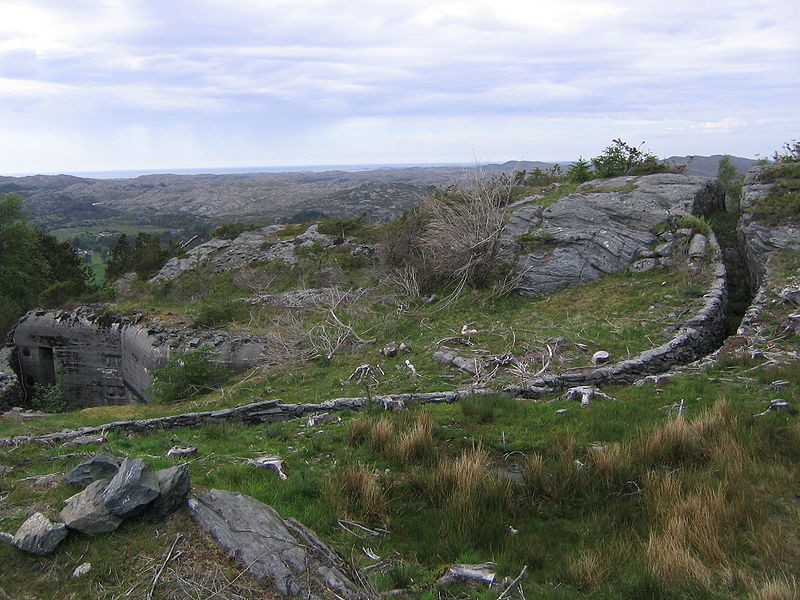
 Above:  Communications trench, notice the exclusive use of natural materials.

Most of these positions feature natural rock from the surrounding landscape.  This creates  an often seamless veil, so that even when looking at one of these Fjell positions, one cannot be sure if it is an artificial feature or a natural one!  The trench walls are all lined with local stone, and so are the mortar positions.  Many of the regelbau bunkers here also incorporate rock in the spaces in between the concrete and ground/grass.  Using this local natural rock, not only of course creates a great camouflage effect, but also reduces the amount of materials that must be brought in from elsewhere.

 Above:  M-19 automatic mortar launcher in action.  Purpose built for forts like Fjell.

 Above:  The firing port for a type 633 regelbau and ventilation pipe.

This next position is circled in purple in the previous map. In the picture above,  notice the metallic "cap" or cover piece on the ground, and to the left.  This is the armored dome to a regelbau type 633, which housed an M-19 Maschinengranatwerfer (grenade thrower machine).  This machine was invented in 1934 to defend permanent military installations.  The M-19 fired a 5 cm mortar, up to 120 rounds per minute, out to 750 meters.  This higher rate of fire was rarely used though, as it caused much stress to the complicated mechanical system.  To operate the M-19 a two man crew was required; however, others were needed to prepare munitions while firing.  To the right a ventilation pipe can be seen.  

 Above:  Trench connecting to a standalone ringstand near the western slope of the mountain.

 Above:  Looking down into the same ringstand.

 Above:  Inside the same ringstand.

 Above:  Entrance to the same ringstand.


Ringstand are very common here.  Some sit on the roof of a larger bunker, and some are standalone concrete positions.  They all connect to the trench system and help to secure not only the perimeter of the main gun and tunnels, but also provide security inside the perimeter in case of enemy penetration. 

 Above:  Posts for razor wire fence can still be found in abundance.  I straightened these posts upright for the picture.

 Above:  Picture taken years ago, but an excellent shot illustrating the simple and effective road block further down the main mountain road.


Posts for razor wire are everywhere, and help to illustrate just how difficult it would be to approach this complex if you were unwelcome.  An impressive roadblock exists much further down the main road of the mountain.  Balanced on top of rock piles, are a number of massive boulders.  These run parallel to the (very) narrow road on both sides.  Attached to each rock used to be a small explosive charge.  When set off these boulders would be blown onto the road, making any crossing by vehicle quite impossible.

 Above:  An old German leitstand, now used for Norwegian weather tracking.


 Above:  To the right of the previous photo lies this huge armored cloche.

Radar equipment can be seen in the first of the two pictures above.  This leitstand (control bunker) was used after the war by NATO as a radar site until recently. The Norwegians still use this position for weather forecasting, and it is surrounded by a high fence.  Notice the Norwegian colors flying to the right.  The photo immediately following is the same bunker, but panned to the right.  The prominent white structure is an Sk für Sechsschartenturm 35P8.  This is a heavily armored cloche, or dome.  Six evenly spaced embrasures line the circumference of the cloche, allowing for two machine guns to simultaneously fire in opposing 180 degree arcs.  This formidable piece of engineering dominates the approaches to the main gun, tunnel system, leitstand, and surrounding area. This position also connects to the tunnel network under the mountain.  The leitstand and armored cloche are circled in red in the map above.

Above:  Trenches near the western slope connect to an overgrown mortar pit.  
 
Above:  Another mortar pit, this one is further to the east.
 
There are a few mortar pits attached to the trench system in this area.  In the photos above notice the platform of rock in the center of the pit.  This is where the mortar was placed and fired. While a bit overgrown with plant life, you can still see the crew positions on either side of the rock shelf, in the form of two deeper depressions.  All of these mortar pits are well camouflaged and made from local rock. 

Above:  A machine gun embrasure covering the entrance to a regelbau.

 
 Above:  The entrance to a standalone ringstand on the northeastern end of the perimeter.

 
Above:  A regelbau type 672 (gun shelter), along the road which leads to the previously illustrated leitstand.  In the map above it is circled in blue, and the farthest bunker to the right.

Next time in this series, I will discuss the subterranean complex and main gun shaft for heavy turret "Felix".  There will be plenty more color photographs (and many of them underground), of the largest fortress built in Norway by the Germans, Fjell Festning!

Wednesday, September 12, 2012

Fjell Festning: A Brief Overview 1

Above:  A trench connecting to regelbau and field positions.  Picture taken five years ago, but a great shot revealing the hidden nature of the facility.

Fjell Fortress (or Fjell Festning if you are Norwegian) exists on the fringes of the busy town Bergen in southwestern Norway.  This fort is actually a massive gun turret, and series of tunnels and rooms built beneath a mountain.  With a great number of surrounding bunkers and smaller gun positions to protect the perimeter, main gun, and tunnel entrances.  This was the largest fortress built in Norway by the Germans, and the third largest fortress built by the Third Reich in general.  Fjell Festning was still in use by NATO until 2003.

 Above:  A map showing the location of Fjell Fortress in relation to Bergen and associated communities Straume, and Fjell.

The day we arrived it was a bit cold,  foggy, and consistently showering us with a light drizzle of rain. The terrain is hilly and often steep.  The surrounding countryside is very lush, with many ferns and pine trees.  Some of the bunkers are currently overgrown with ferns and fauna of various sorts, and locked steel doors prevent access into many of the bunkers and smaller tunnels.  All, or nearly all of these positions are masterfully camouflaged.  Often it is only from one direction that these regelbau bunkers can be looked at and recognized for what they are.  When standing on top of these bunkers, an attached ringstand or ventilation pipe is often the only clue as the to nature of the inconspicuous "mound".  Additionally, since many of these bunkers are built into the side of a hill, there is no "mound" worth mentioning, only an extension of the natural slope of the hill itself.  From the air the 283 mm triple gun turret could easily be seen, but the rest of the compound must have been almost invisible.


The entire fortress as a whole actually covers much more ground than what the display above shows.  An abundance of other bunkers, Flak positions, artillery positions, road blocks, military buildings, and trenches exist in the surrounding areas, all built to compliment the subterranean complex and naval gun at the top of the mountain.  Standing in the area that the above map displays, gives one little to no clue, that there are in fact many long tunnels and big rooms deep beneath your feet. This primitive map simply illustrates the positions in the immediate vicinity of the triple 283 mm turret, which was certainly the centerpiece of the fort.

Above:  Ringstand on top of the same 629.

Above:  Type 629 regelbau with trench.      

The bunker in the two pictures above is the southern most of those located next to the main gun turret, and acted as part of a perimeter defense network.  Its location can be identified by the blue circle indicated in the map above.  This Regelbau bunker was a type 629 sonderausfuhrung (special version).  Type 629s were PAK (anti-tank) shelters.  This one probably held a smaller caliber weapon such as the 3.7 cm PAK 36.  This gun would be kept in the shelter when not in use, or when under artillery attack.  It would then be wheeled out of the bunker into a firing position when the time came to fight.  Notice the dark subterranean entrance.  This is actually an entrance/exit to a system of communication trenches.  A short flight of steps can be seen on the right, disappearing into the bunker wall.  This leads to a ringstand which sits camouflaged atop the bunker, and offers a 360 degree field of fire.  It does not connect to the rest of the bunker internally.   

Above:  3.7 cm Panzer Abwehr Kanone (anti-tank cannon).  The 629 gun shelter in question probably contained one of these.

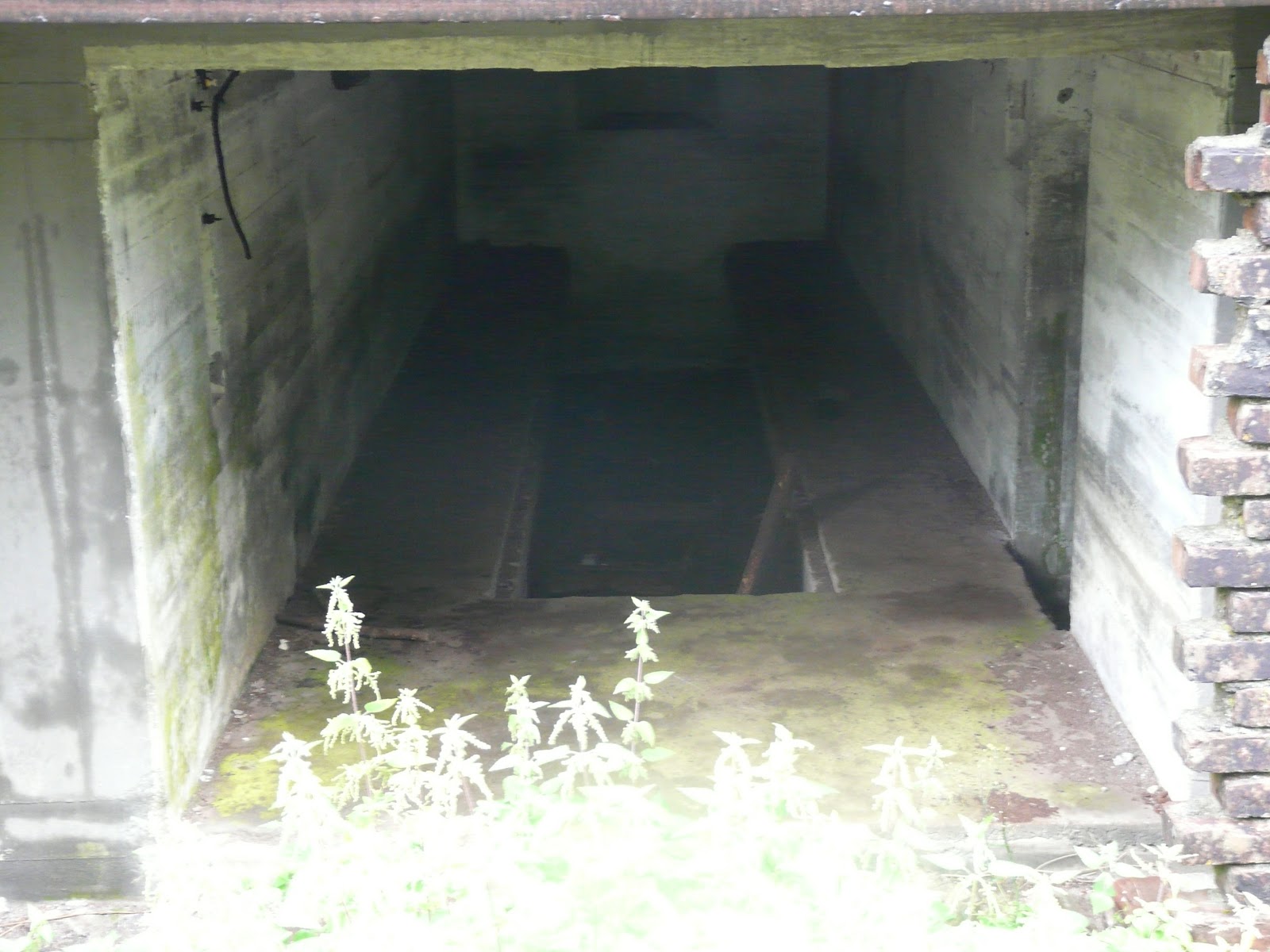
 Above:  The garage for a smaller caliber PAK in the same regelbau 629.

Just out of sight, and immediately to the right in the picture displaying the trench and ringstand entrance, is the gun garage.  Notice the hollow floor center.  This space would be used to store munitions for the gun assigned to this shelter, and would be covered by easily removable wooden planks most of the time.  I could not find a proper door here, or the remains of one for that matter.  As the site was never completely finished, it is possible that an armored door was never installed.  Note the brickwork in the right of the picture.  This leads me to believe that after the war the Norwegians may have bricked the garage up to keep people out of the bunker.  A number of other similar bunkers had this brickwork present as well.

Above:  The trench entrance/exit is more of a tunnel...

 Above:  ..and then opens up to sky and light.
 
The entrance to the trench system here runs underground for a short distance before reaching the surface and open sky.  This then twists and turns for a long distance, connecting with many other bunkers and field fortifications.  From the top these are very hard to see.  The trench system will be covered more in later posts.

Above:  The same 629 shelter, looking back from the trench entrance.  Notice the garage on the left.

More to come soon!  Fjell Festning:  A Brief Overview 2


Friday, August 31, 2012

Intro to bunkers.

Norway and Iceland were wonderful, but now I am back in the United States.  I have some good pictures of Fjell Fortress in Bergen, Norway.  I will use many of these in an ongoing series of posts about Axis bunkers, and in detail pertaining to Fjell Fortress.  Until then,  here are just a few key points about some of the basics of German bunker design and relevant terminology.  They will probably come up again often in later posts.


 Above:  The firing position in a "Tobruk".

Ringstand:  Also known to the Allies as "Tobruks", in reference to very similar Italian positions encountered outside of Tobruk, Libya.  Ringstand are holes in the ground, generally made of concrete.  There is room for one man in this hole to operate a heavy weapon, such as a machine gun or shoulder launched anti-tank weapon.  A Ringstand protected all but the top of a mans shoulders and his head.  Many of these positions had an armored shield that could mount a machine gun, and rotate with the soldier 360 degrees.  Connecting to the hole was a waiting room with a bench, which then connected to a small entry chamber and exit.  Frequently Ringstand were also installed on the roofs of larger bunkers.  In those cases the Ringstand did not connect to the rest of the bunker proper.  These positions were popular because they were cheap and easy to produce (as far as bunkers go), and proved to be very effective for their intended role.  


Above:  The layout for a Regelbau type bunker. 

Regelbau:  When reading or hearing about German bunkers built through the 30s and 40s, you will hear this term a lot.  Regelbau was a term given to a highly successful series of bunker designs that could be standardized in development and construction, and sometimes even be prefabricated.  An advantage of this kind of planning was that many of these bunkers were well rounded in their role for defense, since they all had to be standardized to a set of principals.  Think of Regelbau bunkers as "regulation bunkers".


Above:  In the steep, narrow walls of a communications trench.

Communications Trench:  It is relevant to note that this does not refer exclusively to the act of passing one message to another.  Communications refers to the ability to move not only information, but of material, men and equipment.  Thus a road which your supply columns use will also be referred to as a communications network.  A communications trench then for example, is not necessarily designed to fight from, but instead to move in. Although in some cases it could be a part of a fighting position.  More than likely the trench walls will be too high, or without enough places to step up high and fight.  The walls are very narrow and steep, in order to better protect occupants from explosive or shrapnel effects.  This also tends to make it harder to see.  Communications trenches are vital for static defense, and positional warfare.


Above:  Flak 38, 4 x 20 mm guns.

Flak:  This is a reference to German anti-aircraft weapons systems.  The term covers a wide swath of machines.  The most common German systems of the second world war used combinations of 20 mm auto cannons in single, double, triple and quadruple mounts.  Single or double mounts for heavier 37 mm auto cannons, and of course the famous 88 mm Flak 36 all purpose gun.  Other weapon systems included the deadly 128 mm Flak 40.

Friday, August 24, 2012

Just for fun, and a taste of things to come.

Fjell Fortress is amazing, and I look forward to sharing more about it.  I am still out of country for the moment; however, here are a few photos for fun, and for a taste of future blogs to come.


Above:  A smaller Regelbau bunker for perimeter defense with connecting communications trench.  While just out of sight in the camera shot, a Ringstande lies on top of this bunker.  This is basically a neck-high hole in the bunker roof, specially designed to allow a man with a machine gun to cover the position.  One can turn and fire a full 360 degrees in such a hole.


Above:  A variety of rocket projectiles.  To the far right are two more modern "Cold War" era American designed L.A.W. launchers.  The two longer devices in the middle and far left are German Panzerfaust (tank fist) rocket propelled grenades.  These were disposable, one time use weapons.  They used a shaped charge capable of defeating the armor of any Allied or Comintern vehicle of the time.


Above:  For many, this machine needs no introduction.  Maschinengewehr model 1942.  Or more colloquially MG-42.  Also known as the "Circle Saw", "Buzz Saw", or "Hitler Saw".  With an average rate of fire at 1200 rounds per minute, it could very literally cut a man in two.  This one is attached to a heavy mount for the sustained fire role.


Above:  Just one of many tunnels under the mountain at Fortress Fjell.